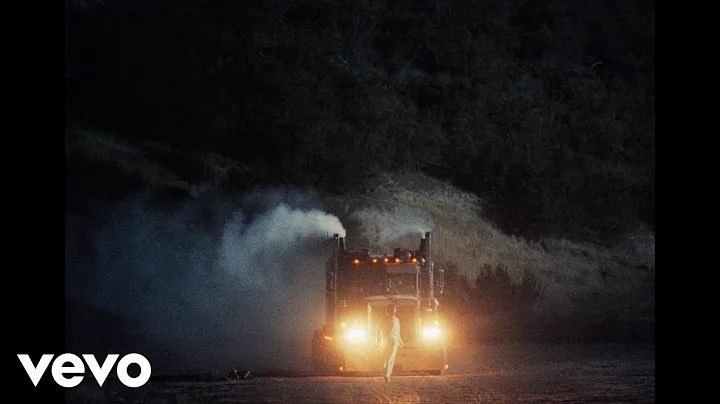
The Sound
The opening piano notes of "Stars Misaligned II" hit with the weight of a confession — simple, slightly detuned, as if the ivory itself is weary. It's a loop that could live on a Drake B-side or a Burna Boy interlude, but here it's given room to breathe, suspended over a trap-laced Afropiano groove that never rushes. The bass is subby and round, more felt than heard, while the hi-hats skitter like rain on a tin roof. This is not the celebratory Afropiano of summer playlists; this is the 2 AM version, where the party has thinned out and only the real ones remain.
The production, handled by Zion Beatz, is a masterclass in restraint. Where many contemporary Afropiano tracks pile on layers — log drums, talking drums, synth pads, vocal chops — "Stars Misaligned II" strips everything back. The piano carries the harmonic weight. A single, delayed guitar pluck adds texture. The kick drum hits with a satisfying thump, but it's the snare that cuts through, crisp and immediate. This is production designed for headphones, for solitary listening, for the moment when the noise of the world fades and only the music remains.
Vocally, the track is a triumvirate of contrasts. oSHAMO brings a raspy, almost-gritty delivery that grounds the song in streetwise reality. Shiloh Yodellé floats above with a tenor that's both vulnerable and commanding, reminiscent of early Wizkid but with a darker edge. Abefe acts as the melodic anchor, his smoother tone weaving through the chorus like a thread of hope in a tapestry of despair. Together, they create a vocal ecosystem that feels less like a collaboration and more like a conversation between three facets of the same broken heart.
Deep Dive
What makes "Stars Misaligned II" work is its structural audacity. The track opens with a 16-bar piano intro — a bold move in an era where attention spans are measured in seconds. But this intro isn't filler; it's a mood-setter, a sonic palate cleanser that forces the listener to lean in. When oSHAMO enters, the shift is jarring yet perfect. His verse is delivered in a conversational cadence, almost spoken-word, before the beat fully locks in. This push-and-pull between chaos and order defines the entire arrangement.
The songwriting is deceptively simple. The hook — "Stars misaligned, but we still shine" — is the kind of line that sounds obvious in retrospect, but that's the mark of great pop writing. It's universal enough to be a mantra, specific enough to feel personal. The verses trade in concrete imagery: "Midnight texts that you never replied" and "Cigarette smoke in a borrowed ride." These are not abstract emotions; they're scenes from a life lived in the margins of love and loss.
Harmonically, the track stays in a minor key throughout, never resolving fully. The piano loop cycles through four chords — i, VII, VI, III — a progression that feels both ancient and modern. There's a subtle modulation in the bridge (around the 2:30 mark) that lifts the energy without breaking the mood. The production trick here is the introduction of a reversed piano sample, creating a swell that mimics the feeling of hope before it's snatched away. It's a cheap trick in lesser hands, but Zion Beatz executes it with surgical precision.
The vocal arrangement deserves special mention. Each artist occupies a distinct frequency range: oSHAMO lives in the low-mids, Shiloh in the upper-mids, and Abefe in the highs. This creates a stereo image that feels three-dimensional. The ad-libs are sparse but effective — a whispered "yeah" here, a breathy "oh" there. Nothing is wasted. The final 30 seconds feature a call-and-response between Shiloh and Abefe that builds to a climax before the piano loop fades out, leaving only the sound of a single, unresolved chord. It's the kind of ending that demands a replay.
Industry Context
"Stars Misaligned II" arrives via emPawa Africa, the label and distribution platform founded by Mr Eazi that has become a proving ground for Afropiano's next generation. emPawa's model is uniquely suited to the streaming era: they provide upfront funding for production and video, global distribution, and marketing support, while allowing artists to retain ownership of their masters. This is not a traditional label deal; it's a partnership that prioritizes artist equity. In a landscape where major labels still extract onerous terms, emPawa's approach is both ethical and strategically smart.
The track's release date — May 15, 2026 — positions it for the summer streaming surge. Historically, Afropiano tracks peak between June and August, driven by festival playlists, travel vibes, and the European holiday season. The fact that "Stars Misaligned II" is darker, more introspective than typical summer fare is a calculated risk. It could be the counter-programming that cuts through the noise, or it could get lost in the shuffle of upbeat bangers. Early streaming data (if available) would be telling: are listeners saving it to playlists or skipping after 30 seconds?
From a marketing perspective, the track's title and theme are perfectly aligned with current cultural currents. "Stars misaligned" speaks to a generation raised on astrology memes, cosmic anxiety, and the feeling that the universe is conspiring against them. This is not accidental. The song's visual aesthetic (likely moody, cinematic, with celestial imagery) will play well on TikTok, where users already create content around themes of fate, timing, and heartbreak. The challenge will be converting that engagement into sustained streaming numbers.
Cultural Impact
"Stars Misaligned II" arrives at a fascinating inflection point for Afropiano. The genre has moved from underground to mainstream, from Lagos to London to Los Angeles, but with that growth comes the risk of homogeneity. Every track now features log drums, a catchy hook, and a feature from a Nigerian artist. "Stars Misaligned II" pushes back against this formula by embracing melancholy. It's a reminder that Afropiano can be sad, contemplative, and still danceable. This is the genre's '808s & Heartbreak' moment — not in sound, but in spirit.
The track's three-artist format also reflects a broader trend in streaming-era music: the rise of the collaborative single as a business model. By pooling fanbases, oSHAMO, Shiloh Yodellé, and Abefe each bring their own audiences to the table. This is playlist math at its finest. The track is more likely to appear on multiple 'Release Radar' and 'Discover Weekly' playlists, increasing its algorithmic reach. It's a strategy that indie artists should study closely: collaboration isn't just creative; it's distribution.
Culturally, the track speaks to the Nigerian diaspora experience — the sense of being caught between worlds, of loving from a distance, of feeling that the stars themselves are against you. This is not a new theme in Afropiano, but the execution here feels fresh. The production nods to American trap and UK drill without ever losing its Afropiano core. It's a sound that could only be made by artists who grew up on Fela, Drake, and Dave in equal measure.
For Music Creators
There are several lessons here for producers and songwriters. First: trust the loop. The entire track is built on a four-bar piano loop that repeats without variation for three and a half minutes. In a world of maximalist production, this restraint is a superpower. The loop becomes hypnotic, allowing the vocals to carry the narrative. Producers should experiment with building tracks around a single, compelling loop and seeing how far they can push it before adding new elements.
Second: vocal arrangement is a production tool. The way oSHAMO, Shiloh, and Abefe trade lines, harmonize, and leave space for each other is a masterclass in arrangement. Creators should study the stereo panning and frequency separation in this track. Notice how the ad-libs are placed in the sides, leaving the center for the lead vocal. Use reference tracks like this to train your ear for spatial mixing.
Third: lean into lyrical specificity. "Midnight texts" and "cigarette smoke" are not generic; they're sensory. Songwriters should avoid abstract declarations of love or loss and instead describe the scene. The more specific the image, the more universal the emotion. The hook's cosmic metaphor works because it's grounded in relatable human experience.
Finally: consider the three-artist collaboration model. If you're an indie artist, find two others with complementary styles and fanbases. Release a single together. Cross-promote on social media. The combined reach will always exceed the sum of its parts. Just make sure the song is strong enough to justify the feature — no one benefits from a weak track.
Verdict
"Stars Misaligned II" is a significant release, not because it will dominate the charts (though it might), but because it represents a maturation of Afropiano as a vehicle for emotional complexity. It's a track that rewards repeated listens, revealing new details in the production and new layers in the lyrics with each play. For fans of the genre, it's a breath of fresh, melancholy air. For creators, it's a textbook example of how to make less feel like more.
Will it last? The piano loop will age well, but the trap elements may date it. Still, the songwriting is strong enough to transcend production trends. This is a track that will find its way onto late-night playlists and heartbreak mixtapes for years to come. Who should listen? Anyone who thinks Afropiano is just for parties. Anyone who has ever felt that the universe was working against them. And anyone who wants to hear three artists at the top of their game, making something real.